

Latest Weather Blog
Category 6 possible in proposed new hurricane scale that considers all hazards
A new study suggests that a redesigned hurricane warning scale helps people better understand storm risks and make more informed decisions about whether to evacuate.
Research from the University of South Florida compares the traditional Saffir-Simpson Hurricane Wind Scale (SSHWS), which ranks hurricanes from 1 to 5 based on maximum sustained wind speed, with a newly developed Tropical Cyclone Severity Scale (TCSS). Researchers say the traditional scale can be misleading because it only accounts for wind, even though storm surge and rainfall are responsible for far more deaths.
“I kept finding time and time again that people would report that they would base their decision to evacuate largely on the category from the Saffir Simpson hurricane wind scale,” said Doctor Jennifer Collins, one of the project's researchers.
According to the study, storm surge accounts for 49 percent of U.S. hurricane fatalities and rainfall accounts for 27 percent, compared to just 8 percent from wind. Researchers say classifying a hurricane's threat based on wind speed alone does not capture its full severity.
The study points to Hurricane Katrina in 2005 as an example. Katrina ranked as a Category 3 on the SSHWS but caused more than 1,800 casualties and $125 billion in damage due to extreme flooding from storm surge and rainfall.
Researchers also cite Hurricane Sandy in 2012 and Hurricane Florence in 2018. Florence made landfall as a Category 1 hurricane in South Carolina and resulted in 55 fatalities from freshwater flooding across the southeastern United States.
“The cat. ones and even tropical storms can have major rainfall, for instance, or storm surge and result in flooding and loss of life. So, I think it is a big mistake. I think people underestimate, especially, those lower categories of storm,” said Collins.
Trending News
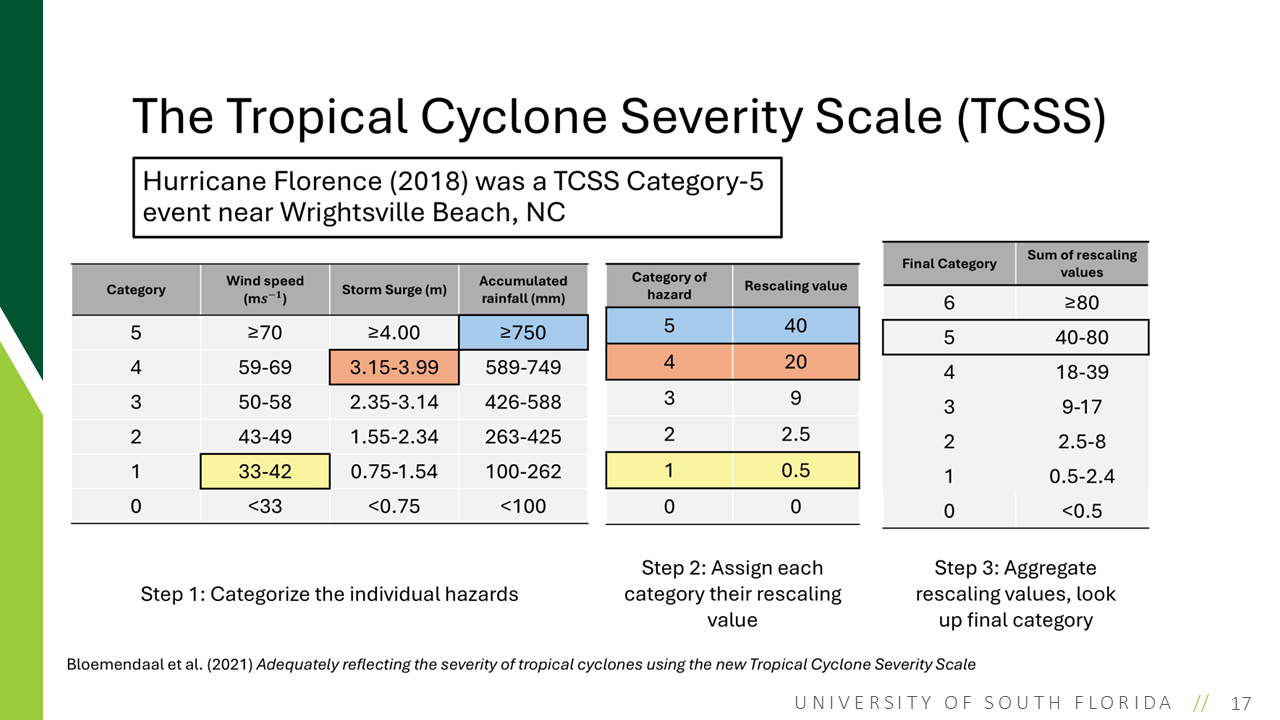 Proposed Tropical Cyclone Severity Scale (TCSS)
The new scale would consider the forecast for all three main hurricane hazards – wind, storm surge and rain. Each of those hazards would be assigned a value. The values for each of the three hazards would be added together to get a sum value that corresponds to the Category on the TCSS. With the TCSS, a particularly intense storm that is expected to bring major impacts from two or three of the hazards could lead to a category six.
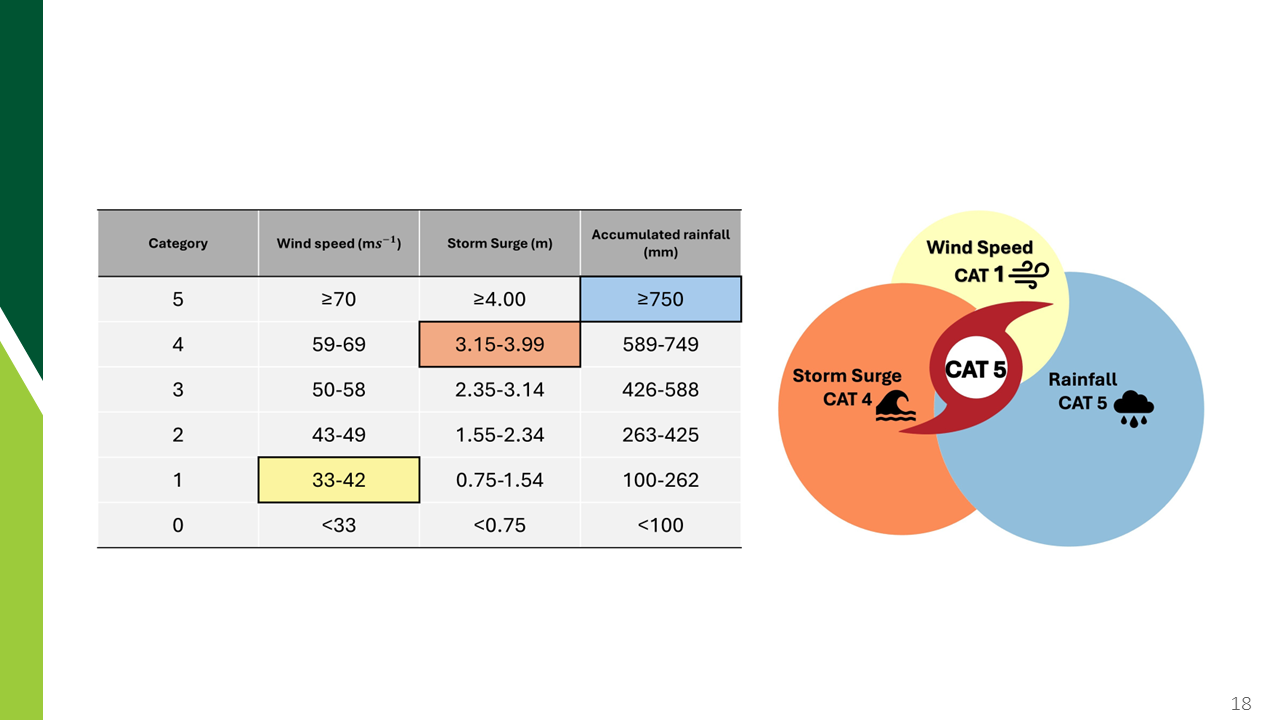 Proposed Tropical Cyclone Severity Scale (TCSS) Example
To test the new scale, researchers ran a large online experiment with about 4,000 participants in U.S. coastal states prone to hurricanes. Participants were randomly assigned to receive warnings using either the SSHWS or the TCSS, presented as text only or text with a graphic.
Participants using the TCSS were better at identifying the main hazard of a hurricane. Those exposed to TCSS warnings answered an average of 3.7 out of 10 quiz questions correctly, compared to 1.3 correct answers for those who received SSHWS warnings.
Evacuation intent was also higher under the TCSS in scenarios where the TCSS category was at least two categories higher than the SSHWS category. In those cases, average evacuation intent was 4.3 under TCSS versus 4.1 under SSHWS, a statistically significant difference.
On precautionary measures, the TCSS appeared to have a positive effect, though not always at the researchers' stated significance level. Sandbag adoption was higher in the TCSS group, with a mean of 3.24 versus 3.16, but researchers described that difference as inconclusive because it did not reach their preregistered significance threshold.
The study also notes that many people incorrectly assume hurricane damage increases in a straight line as the category number goes up. Researchers say this misunderstanding, combined with a process called "milling" where people delay decisions while searching for more information, can lead to dangerous inaction during a storm.
The National Oceanic and Atmospheric Administration (NOAA) and the National Hurricane Center (NHC) have been trying to de-emphasize scale in recent years, noting how harmful it can be for users to focus on categories. However, researchers argue that people are used to a scale and so the current one should just be modified and account for rain and storm surge, along with wind.
The Storm Station is here for you, on every platform. Your weather updates can be found on News 2, wbrz.com, and the WBRZ WX App on your Apple or Android device. Follow WBRZ Weather on Facebook and X for even more weather updates while you are on the go.
More News

